
How to Start a Business in
Build Your MOAT Before You Burn Out
in the 21st Century
Let’s be honest — starting a business today isn’t about grit anymore.
You can work 80-hour weeks, read all the startup books, and still fail miserably.
Because grit doesn’t save you if you’re grinding in the wrong direction.
These days, hard work only works if you’re solving the right problem for the right market — and doing it from a position of advantage.
That’s where the MOAT comes in.
It’s not the traditional “competitive moat” from business textbooks.
This is a reality check — a framework to know if your idea even deserves your time.

M
ARGIN
Before jumping into any business venture, ask yourself: Does this make at least 15% net margin consistently?
In other words, is the business profitable? A healthy net profit margin means the company earns money on its sales, rather than just covering costs (Investopedia, 2025). If your margins are too low, the business will struggle to survive unexpected challenges or invest in growth.
A business with thin margins might grow fast, but it will collapse the moment something breaks—your health, your costs, or your team. Good margins provide breathing room to experiment, reinvest, and recover from mistakes, whereas low margins trap the business in a constant state of struggle.
Industry Benchmarks: Profit margins vary widely by industry. The average net profit margin across all industries is around 8.5% (Vena Solutions, 2024), so 15% is above average and considered strong for many businesses. For example, the software industry often enjoys net margins in the 20% range or higher, thanks to high gross margins and low marginal costs. On the other hand, retail and manufacturing typically have lower margins – many retailers aim for 5–10% net margins, and manufacturers around 10–15% (On-Ramp Funds, 2025). Even within a single industry, margins can differ significantly depending on business model and efficiency. A small retail store might have only a 5% net margin, while a well-run chain or an e-commerce business could reach 10–15% (On-Ramp Funds, 2025). It’s important to research industry benchmarks to know what to expect. The following chart illustrates these variations, showing a stark contrast between high-margin industries like banking and low-margin industries like farming.
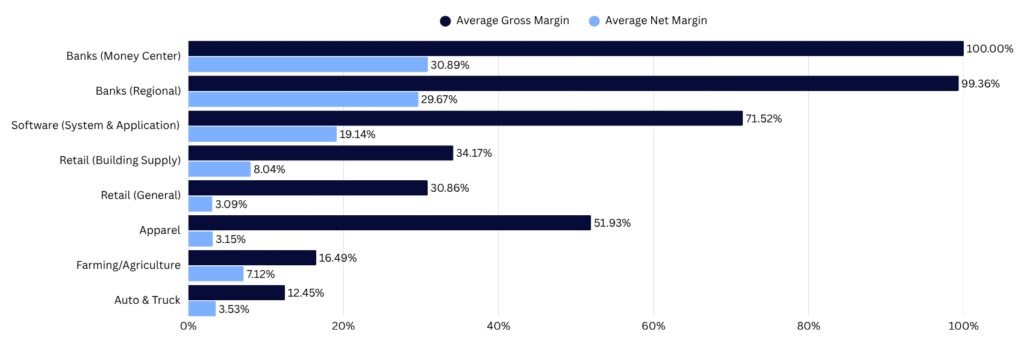
Data Source: Vena Solutions (2024)
Why 15%? A 15% threshold is set because it’s above the typical industry average and gives a business some resilience. At 15% net margin, the company earns a decent return on revenue, which can fund growth initiatives, absorb price pressures, and withstand economic downturns. If your business consistently achieves at least 15% net profit, it’s a strong indicator that the underlying economics are solid. This doesn’t mean you need to hit 15% immediately – startups often have lower margins in early years as they invest in scaling. But over time, as the business matures, aiming for and hitting a healthy margin is crucial. The key is to ensure the business model is sustainable in the long run, not just for a short burst of growth. If your idea can’t achieve a sustainable profit margin (say, below 5%), it may be a sign that the market or business model isn’t well-aligned, and you should reconsider (TrueProfit, 2025).

O
PERATIONS
Once you’ve confirmed that your business can be profitable, the next question is: Can this thing actually scale, or did you just create a job for yourself? Many founders start a business thinking they’ve built something lasting, only to realize it’s essentially a one-person operation. In such cases, the business won’t grow beyond the founder’s capacity – it’s a “glorified freelance career” that collapses the moment the founder stops working. A true scalable business, on the other hand, can continue to operate and grow even when the founder is not directly involved in every task. It has systems, repeatable processes, and a team that can execute without constant supervision.
Scalability vs. Self-Employment: The difference between a scalable business and a non-scalable one is whether it can scale – i.e., grow revenue and output without a proportional increase in input (like time or labor).
If you have to work 80-hour weeks indefinitely to keep the business going, it’s not scalable. You’re essentially trading your time for money in a cycle that can’t be sustained. In contrast, a scalable business will eventually reach a point where it can handle more customers or sales with the same or fewer resources. It has systems in place for tasks like customer acquisition, production, fulfillment, and customer service (Solvexia, 2024). These systems allow the business to grow in a predictable, repeatable way. For example, a SaaS software company might invest in automated marketing and support, so as it adds more users, the cost per new user remains low. A manufacturing business might invest in assembly lines or inventory management software so that it can produce more units with the same workforce. The key is that the operations can be scaled – the business isn’t bottlenecked by one person’s ability.
Testing Operations: Before scaling your business, it’s wise to “test your operations” and ensure they can function without you. This means asking: Can this run without me for a week? If the answer is no, it’s a sign that the business isn’t ready to grow. It may be missing key processes, or perhaps it’s still in a trial-and-error phase. For instance, if you’re a sole proprietor who handles every order personally, you need to create a process for order fulfillment, train a team member, or automate some part of it so that the business can continue in your absence. If you’re a service provider who has to do each job yourself, you need to develop a standardized service process or hire staff to deliver the service. By ensuring the business can operate effectively even when you’re not actively involved, you’re building a foundation that can support growth.
Systems, Processes, and Team: A scalable business is characterized by systems and repeatable processes. This includes things like how to acquire new customers, how to deliver the product or service, how to handle returns or complaints, and how to manage finances. These processes should be documented and, ideally, automated or delegated. Additionally, a scalable business has a team in place that can execute these processes. Even if you’re the founder, you should be able to trust others to do their jobs. This might involve hiring employees, contractors, or using freelancers, or it might mean outsourcing certain functions. The goal is to reduce dependency on any single individual. Without systems, repeatable processes, and people who can execute, what you have isn’t entrepreneurship—it’s self-employment dressed in a logo. By building systems and a capable team, you transform a one-person operation into a true business that can scale.

Importance of Scalability: Scalability is crucial because it allows a business to grow its revenue without proportionally increasing costs. In the long run, a scalable model can achieve economies of scale and higher profits as it grows. Conversely, a non-scalable business will face diminishing returns – each additional sale or customer might require a significant investment of time or money, which limits growth. Many businesses that start as one-person operations end up failing when they try to scale, not because the product or market is bad, but because they never built the systems needed to handle growth (U.S. Chamber of Commerce, n.d.). By focusing on operations and ensuring scalability, you set your business up for sustainable growth. It’s not just about making money today, but about building a business that can continue to succeed tomorrow and beyond. A real business runs without you in every task. This is the mark of a solid foundation – one that can weather the founder’s absence and continue to operate and grow.
A
DVANTAGE
Over time, every business model gets copied. So, what gives you an unfair advantage? This is your “moat”—a sustainable edge that competitors can’t easily replicate (Mauboussin & Callahan, 2024). An advantage isn’t just a good idea; it’s something unique to you. It could be years of specific industry experience, insider knowledge, deep connections, or a proprietary technology. Without an unfair advantage, you’re stuck in a race to the bottom, competing on price or speed. The best founders don’t chase random ideas; they build from their edge. While competitors are just figuring things out, you’re already operating with context and a head start.
T
otal Addressable Market
This is where founders either dream too small or way too big. Ask yourself: Is this market big enough for what I want? Not every business needs to be a billion-dollar rocket ship.

As Antler (n.d.) points out, some founders are happier running a $2M lifestyle business with high margins than chasing venture funding. The key is alignment. Build a business that’s the right size for your goals. If the market can sustain your desired outcome—whether that’s $200K a year or $20M—then you’re playing the right game. Avoid the “1% of a huge market” trap; instead, be realistic about the market you can actually capture and whether it matches your ambitions.
In the 21st century, starting a business isn’t about being the hardest worker in the room—it’s about being the most self-aware. Before you start, ask yourself why you’re doing this and what you truly want from it. The road ahead is difficult, but if your reason is bigger than the challenges, the work becomes worth it.
Figure out your MOAT—Margin, Operations, Advantage, and Total Addressable Market. If you can tick all four boxes, you’ve earned the right to go all in. Because once your MOAT is real, grit becomes your fuel, not just a tool for survival.

At DBPSC Global Solutions, we help entrepreneurs and growing businesses strengthen their operational foundations through strategic Virtual Assistant support. From streamlining workflows to optimizing processes, our team enables you to focus on vision, strategy, and building your true competitive advantage.
Visit DBPSC Global Solutions to discover how the right virtual partnership can help you build smarter, scale faster, and protect your business moat.
Contact Us
Please fill out the form below to get in touch.