
61% of Business Leaders Say
AI Is Their #1 Priority.
Only 34% Are Doing It Right.
Here’s the Gap.
Every leader says AI transformation is their top priority. But INSEAD, Deloitte, and PwC all agree — the vast majority are scratching the surface. The difference between talking about AI and actually profiting from it comes down to one thing: the human infrastructure behind the technology.
What the world’s top research institutions say about AI adoption in 2026
Over 61% of INSEAD faculty identified AI and digital transformation as the single most important area businesses must address in 2026 — with 44% simultaneously flagging it as a key threat. Of every force reshaping the global economy, AI stands alone as both the biggest growth opportunity and the most significant structural risk.
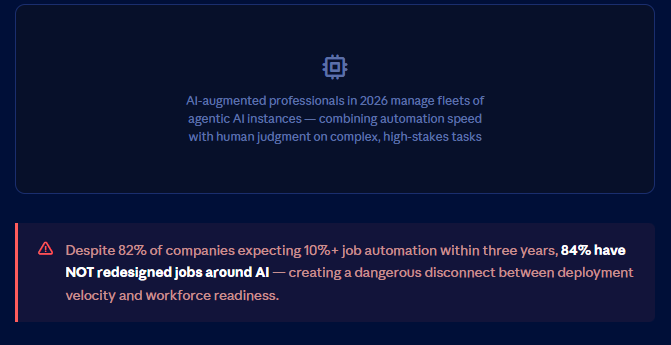
Deloitte’s State of AI in the Enterprise 2026 — based on 3,200+ business and IT leaders across 24 countries — confirms the ambition but exposes the execution gap. Only 34% of organizations are truly reimagining their businesses around AI. The remaining two-thirds? Either making incremental process changes or running AI tools with zero structural change underneath them.
61%
NSEAD · FEB 2026
Faculty naming AI & digital transformation as the #1 business priority
34%
DELOITTE · JAN 2026
Organizations truly reimagining their business around AI
37%
DELOITTE · JAN 2026
Still using AI at surface level — no change to existing processes
84%
DELOITTE · JAN 2026
Increasing AI investment — while 84% have NOT redesigned jobs around AI

The math is stark: 84% of business leaders are increasing AI investment, yet the same share have not redesigned the jobs, workflows, or talent infrastructure required to make that investment pay off. More money flowing into a structure that hasn’t changed is not a transformation strategy — it’s an expensive experiment.
Three tiers of AI adoption — and only one that creates lasting advantage
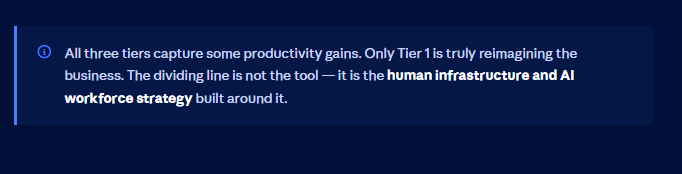
Deloitte’s 2026 research reveals three distinct groups of AI adopters: one-third (34%) using AI to deeply transform their businesses — creating new products or reinventing core processes; another third (30%) redesigning key processes around AI; and the remaining third (37%) using AI at a surface level with little to no change to existing operations.
34%
Tier 1 — Deep Transformers
Creating new products, reinventing core business models, and building AI-native infrastructure. These are the only companies generating structural, compounding advantage.
30%
Tier 2 — Process Redesigners
Rebuilding key workflows around AI. Capturing real efficiency gains but not yet transforming the business model itself.
37%
Tier 3 — Surface Users
Using AI tools without changing processes or structures. Productivity bumps only — falling behind fast as Tier 1 competitors widen the gap.
“Insufficient worker skills rank as the top obstacle to integrating AI into existing workflows — not technology limitations, budget constraints, or leadership skepticism.”
— DELOITTE, STATE OF AI IN THE ENTERPRISE, 2026 (3,200+ LEADERS · 24 COUNTRIES)
The AI skills gap is not a pipeline problem — it’s a structural emergency
A 2026 DataCamp study found that 82% of enterprise leaders say their organization provides AI training — yet 59% still report an AI skills gap. Only 35% have a mature, organization-wide AI upskilling program. Most training is fragmented, optional, and disconnected from actual job tasks.
This is the critical insight the data keeps surfacing: organizations aren’t failing because they lack AI tools for business. They’re failing because they lack people who know how to deploy those tools inside real workflows — verify outputs, manage quality, build governance, and translate AI capability into decisions and results.
PWC · 2025
56%
Wage premium earned by AI-skilled workers vs. non-AI workers
McKINSEY · 2026
3-4X
Better productivity for “AI Leader” orgs vs. “AI Beginners”
DELOITTE · 2026
50%
Still using AI at surface level — no change to existing processes
WEF · 2025
39%
Of core worker skills expected to change by 2030 due to AI
Workers with verified AI skills command a 56% wage premium (PwC). Organizations McKinsey classifies as AI Leaders — those with comprehensive AI workforce training programs — achieve 3–4× better productivity, innovation, and employee satisfaction than AI Beginners. The gap is structural, compounding, and widening fast.
Agentic AI: the wave most businesses aren’t built for
Only 23% of organizations use agentic AI meaningfully today — but 74% expect moderate-to-full integration within two years, driven primarily by customer support, supply chain, and R&D. Agentic AI is the leap from tools that respond to tools that act: autonomously executing multi-step workflows with limited human input.
This is where the human infrastructure gap becomes genuinely dangerous. Agentic AI operating inside under-designed workflows is not just inefficient — it is a liability. By 2027, half of companies using generative AI are expected to launch agentic AI applications. Only 21% currently have mature governance models to manage them.
The AI governance deficit: the risk layer most organizations are completely ignoring
Speed and ambition are creating a governance gap that few organizations are taking seriously — and the numbers on this are alarming.
21%
DELOITTE · 2026
Organizations with mature governance models for autonomous AI agents
73%
DELOITTE · 2026
Cite data privacy and security as their top AI risk — yet governance lags
25%
DELOITTE · 2026
Leaders reporting transformative AI impact — up from just 12% a year ago
39%
Of core worker skills expected to change by 2030 due to AI
Only 1 in 5 organizations has a mature governance model for autonomous AI agents — yet 74% plan to deploy them at scale within two years. The gap between deployment velocity and governance maturity is precisely where reputational, legal, and operational failures originate.
How AI-enabled virtual assistants and IT-BPM professionals close the gap
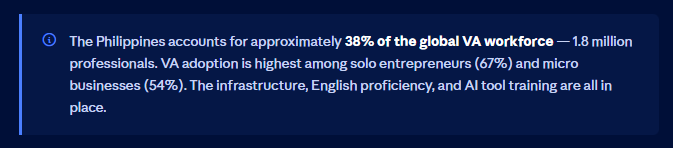
This is precisely the gap that AI-trained virtual assistants and IT-BPM outsourcing professionals exist to close. In 2026, the Philippines has evolved from the “World’s Call Center” to a “Global Intelligence Hub” — generating over $42 billion in annual export revenue, with 1.97 million professionals. While 80% of routine tasks are now automated, Filipino professionals have captured the high-value 20% requiring human judgment, cultural empathy, and complex problem-solving.
$42B
IBPAP · 2026
Philippine IT-BPM projected export revenue — 5% YoY growth
1.97M
IBPAP · 2026
Filipino IT-BPM professionals growing 4% annually
$6.5B
VA MASTERS · 2026
Global dedicated VA services market, 23.4% CAGR to $43.4B by 2035
2–3×
VA MASTERS · 2026
Output multiplier for VAs who integrate AI tools vs. those who don’t
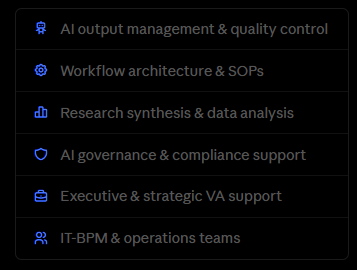
What a trained, AI-enabled VA professional delivers in the context of closing the AI execution gap:
AI outsourcing ROI: what AI-enabled offshore talent costs vs. what it delivers
The business case for Philippines-based AI-enabled virtual assistants has never been stronger. In 2026, cost savings are compounded by the productivity multiplier of AI tool proficiency.
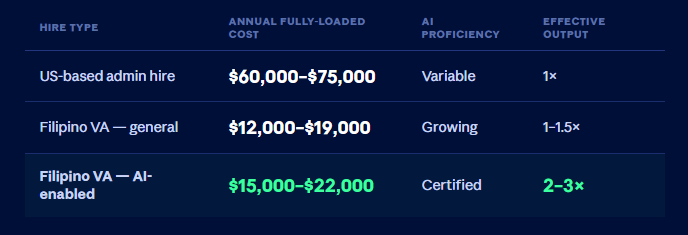
An AI-proficient Filipino VA costs 70–80% less than a US equivalent — while delivering 2–3× the output of a non-AI-proficient hire at any price point. This is no longer just cost arbitrage. It is capability arbitrage — and in 2026, that distinction is what separates the businesses closing the AI execution gap from those watching it widen.
The AI execution gap is a human problem — and it has a human solution
INSEAD, Deloitte, and PwC all point to the same conclusion: the businesses winning with AI in 2026 are not the ones with the most sophisticated tools. They are the ones that have built the human infrastructure for AI — the trained, skilled, accountable people who deploy those tools responsibly, verify their outputs, and translate capability into measurable business results.
61% of business leaders have identified AI as their top priority. Only 34% are doing it right. The gap between those two numbers is not a technology gap. It is a talent and AI strategy gap — and it is exactly the gap that AI-enabled IT-BPM professionals exist to close.
The question for your business is not whether AI transformation will matter. It is whether you will build the human infrastructure to make it work before your competitors do.
Global Solutions · AI-Ready Talent & IT-BPM Services
Bridge the AI execution gap with talent
that’s already trained for it.
We place pre-vetted, AI-enabled virtual assistants and IT-BPM professionals who don’t just use the tools — they manage outputs, build workflows, document processes, and deliver the human infrastructure that makes AI investment actually pay off. Serving businesses across the US, UK, and Australia.
50–80%
cost savings vs. US, UK, or Australian hires
with 2–3× the AI-enabled output
PRE-VETTED · AI-CERTIFIED · READY TO DEPLOY