
Smarter

explores how data-driven pricing strategies can boost profitability, enhance customer trust, and build long-term business resilience in an ever-changing market.
Pricing for a Stronger Future
Here’s something most business owners get wrong: when margins start shrinking, the first instinct is to cut costs. They’ll start trimming headcount, slashing marketing budgets, or delaying new hires. But what often gets overlooked is that pricing is your strongest operational lever — and it costs nothing to change. In fact, a well-crafted price adjustment can have 10 times the impact of an equivalent cost cut . As the famous saying goes, “There is no cost too high to avoid a price cut.” according to McKinsey & Company.
As the famous saying goes, “There is no cost too high to avoid a price cut.” Don’t just cut expenses — raise prices smartly. Let’s explore why pricing should be your go-to strategy for profitability, backed by data and research.
1. Pricing is not just a number — it’s a reflection of your business model
When you treat pricing as a simple math problem (“cost + margin”), you miss the bigger picture. Pricing isn’t just about covering expenses — it’s about communicating value. As a product manager, I’ve seen companies spend months optimizing internal workflows just to save a few percent on expenses — only to ignore the fact that a small, well-structured price adjustment could have driven 10x the impact. For example, consider a service where your operating cost per client is $80 and you charge $100, resulting in a 20% margin. If you raise your price by 10%, your revenue per client jumps to $110. That’s an additional $10 per client — pure profit — without changing a single operational expense. In essence, pricing is your profit margin, and even a 10% increase can significantly boost profitability . That’s pricing power — an operational lever that doesn’t require new capital or efficiency gains. In fact, McKinsey notes that pricing decisions can have a lasting positive impact on profitability, far outperforming many cost-cutting efforts as shown in McKinsey’s analysis of pricing impact.
As Warren Buffett famously said, “If you’ve got the power to raise prices without losing business to a competitor, you’ve got a very good business. And if you have to have a prayer session before raising the price by 10 percent, then you’ve got a terrible business.” This underscores the importance of pricing power and the leverage it provides.
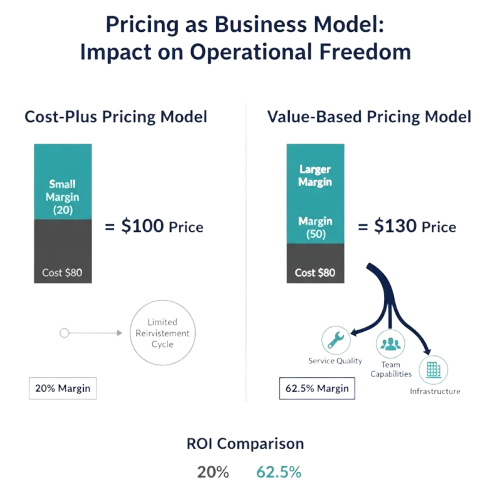
Figure 1: Visualization of how pricing strategy impacts operational freedom and business model sustainability
When done right, pricing aligns with your business model to create a sustainable margin. It’s not just an accounting formula — it’s a strategic choice that defines your value proposition to the market. If you treat pricing as an afterthought or simply an arithmetic calculation, you risk undercharging for your value and leaving money on the table. Instead, think of pricing as a critical component of your strategy: it should reflect the quality of your product or service, your target market, and your long-term goals. A well-thought-out pricing model ensures that you aren’t always forced to cut costs to survive. You can invest in improvements, hire top talent, and grow your business, because your pricing is robust enough to cover those costs. As we’ll see, even a modest price increase can yield outsized returns when combined with smart operational strategies.
2. Your price tells the market what to expect from you
When you underprice, you don’t just lose profit — you also send a message: “We’re cheap, not strategic.” And cheap brands often get treated like vendors, not partners. On the other hand, strategic pricing positions you differently as shown in a Phoenix Strategy Group study . It gives you room to reinvest in better service delivery, stronger infrastructure, and more capable people. This creates a virtuous cycle: healthy margins enable reinvestment, which in turn enhances the value you provide. Over time, this reinvestment cycle — fueled by a healthy margin — can save you from bloated operational costs down the road. It’s like building a buffer against inefficiencies. Let’s break this down. If your pricing doesn’t cover your true costs or value, you’ll be tempted to cut corners or stretch your team thin. This can lead to lower quality, unhappy customers, and eventually more problems. But if you price appropriately, you can afford to invest in training, technology, and support. For example, a software company that underprices might skimp on development and customer support, resulting in a subpar product and churn. But a company that prices for value can afford to hire top developers and support engineers, delivering a better product that customers love.
The difference in quality and customer satisfaction often justifies the price and keeps the company profitable. Strategic pricing isn’t about gouging customers; it’s about communicating that you’re a high-value partner. It allows you to build a reputation for excellence, which can attract even more customers. As one case study noted, companies that align their pricing with customer value not only increase revenue but also deepen customer engagement . This win-win scenario is what every business aims for. By pricing strategically, you also create leverage for your operational decisions. If your price reflects the value you deliver, customers are more likely to accept reasonable adjustments and to work with you in good times and bad. You won’t have to scramble to cut costs when market conditions change, because you’ve already built a margin cushion. In summary, your price is a signal to the market. Set it too low, and you might struggle to survive; set it right, and you can thrive. A well-chosen price can save your business from having to slash costs in the future, because you’ve earned the right to invest in yourself.



3. Pricing gives you leverage over operational efficiency
Here’s the irony: if your prices are too low, your ops team is always under pressure to deliver more with less. That’s where burnout, churn, and inefficiency come in.
Employees might feel stretched thin, and you might find yourself constantly firefighting. Research published in the Indiana Journal of Economics and Business Management if you price correctly — aligned with the complexity and value of your service — you create operational breathing room. You can afford better tools, better training, and ultimately, better results. A sustainable pricing model gives your operations team space to perform, instead of constantly compensating for underpriced deals. Let’s consider an example. Suppose you run a consulting firm that underprices its services. To hit your targets, your consultants might be working 60+ hour weeks, taking on too many projects at once, and making mistakes due to fatigue. This leads to poor client outcomes and more work to fix things. On the flip side, if you charge a fair price for your expertise, you can staff your team appropriately. You might hire additional consultants or support staff, invest in project management software, and ensure your team has time to do their best work. As a result, you deliver higher-quality results, keep clients happy, and avoid burnout. Your operations run smoothly because you’re not overcommitting. This is the power of pricing leverage: it lets you scale your operations to match your pricing. You aren’t forced into a race to the bottom in efficiency; instead, you can improve efficiency as you grow. Good pricing can also encourage your customers to respect your time and process.
When you have a clear price and a reputation for delivering value, clients are less likely to demand endless changes or to haggle on price. This reduces the operational overhead of negotiations and changes, allowing your team to focus on execution. Another way pricing helps efficiency is by enabling smarter resource allocation. If you know your costs and have a profitable price, you can decide which clients or projects are worth pursuing. You might say no to low-margin clients that drain resources, which saves you from inefficient work. Over time, this selective approach improves your overall efficiency and profitability. In essence, pricing is a filter for your business. It helps you pick the work that’s worth doing and avoid the work that isn’t. This not only boosts margins but also protects your team from being overwhelmed. When your pricing model is healthy, you don’t have to rely on sheer volume or low costs to survive. You can operate with a sense of balance and sustainability. So the next time you’re tempted to cut costs (or to work more hours), ask: is this really a cost problem, or is it a pricing problem? Often, a simple price adjustment can save you from the need to make those drastic operational changes. And the best part is, you don’t have to sacrifice quality to do it — you just price for it.
4. Good pricing protects you from bad clients
This one’s often overlooked but it’s one of the most practical truths in business: low pricing attracts high-maintenance clients, while high-value pricing attracts partners who respect your process. As shown in the Global Pricing Study 2025 When your pricing communicates confidence, it filters your market for you. That’s not arrogance — that’s operational strategy. Because servicing the wrong clients costs more than you think. Let’s explain. If you offer your product or service at a very low price, you’re likely to attract customers who are bargain hunters or who have low expectations. These clients might be very price-sensitive, constantly asking for discounts or changes, and generally hard to satisfy. They can eat up a lot of your time and resources with little appreciation. In contrast, if you price at a level that reflects the value you provide, you’ll naturally attract clients who understand and respect your worth.

These clients are willing to pay for quality and are more likely to be reasonable and easy to work with. They trust your pricing and see you as a partner rather than a commodity. The result? You spend less time on negotiations and dealing with issues. For example, imagine two SaaS companies: one charges a very low monthly fee and another charges a premium fee. The low-fee company might end up with clients who are unhappy with minor glitches and demand refunds, whereas the premium company might have clients who, because they paid more, are more forgiving and willing to work with the team to solve problems. The difference in support overhead can be significant. Moreover, high-value clients often bring referrals and long-term loyalty, which is invaluable. By setting a higher price, you also signal that you’re not desperate for every client. This can prevent you from taking on clients that are too small or too demanding, saving you from wasted effort. As the saying goes, “You can’t serve everyone.” Smart pricing helps you choose your customers.
You can focus your energy on clients who will be profitable and who align with your goals, rather than on those who will be a drain. This is not only about money — it’s about sanity. Running a business is easier when you’re not constantly fighting with clients or apologizing for your low prices. Good pricing can save you from operational chaos by reducing the noise of low-value interactions. It allows you to build a steady, manageable client base where both you and your clients benefit. So, next time you’re tempted to undercut the competition, remember: sometimes it’s better to walk away from a deal that doesn’t fit your pricing model. It might hurt short-term volume, but it could save you from long-term headaches. In the long run, charging what you’re worth protects your business from clients who would only stress you out. That’s a smart strategy for your sanity (and your profitability).

5. How to build a pricing model that works for you (not against you)
If you’re rethinking your pricing, start with these questions to ensure you’re building a model that actually saves you from operational chaos, not traps you in it. These questions will help you align your pricing with your business reality and customer expectations. By answering them, you can define whether your pricing strategy will save your business or lead to constant struggle.
What is the real value of the problem we’re solving — not just the time spent solving it?
Rather than pricing solely by time or effort, focus on the outcome and the benefit your client receives — how much are they willing to pay to solve their problem or achieve their goal? For instance, if your tool helps a client save $100,000 a year, setting a price that reflects a meaningful fraction of that value makes sense. This is the essence of value-based pricing, which has been shown to significantly boost profitability. (Homburg, Jensen, & Hahn, 2012).
How much margin do we need to maintain quality without overworking the team?
Sustainable pricing must cover direct costs, overhead, and a healthy profit margin to ensure operational stability and team well-being. Setting margins of 20–30% allows room for reinvestment, preventing burnout and supporting long-term growth. This balance between cost and quality strengthens overall business sustainability (Nagle, Hogan, & Zale, 2016).
Can our pricing scale as our operations scale, or will we end up trapped in volume work?
A scalable pricing model enables revenue growth without costs rising proportionally. Tiered or subscription-based models—common in SaaS—allow businesses to serve more clients efficiently while maintaining profitability. Designing pricing around value and automation supports sustainable, scalable growth (Osterwalder, Pigneur, & Bernarda, 2014)
Are we benchmarking against the market or building a model that reflects our efficiency?
Benchmarking provides context but shouldn’t dictate your pricing—align it with your efficiency, quality, and customer value. Companies that price according to their unique advantages rather than competitors avoid price wars and maintain healthier margins. Sustainable pricing models reflect internal strengths and perceived customer value (Kotler & Keller, 2016)
By answering these questions, you’ll have a clearer path to building a pricing model that works for you and not against you. The goal is to create a pricing strategy that not only maximizes your profitability but also supports your operational sustainability. A well-designed pricing model can save your business from constant cost-cutting and operational chaos, allowing you to focus on growth and innovation. As we’ve discussed, pricing is a powerful lever — use it wisely. And remember, pricing isn’t a one-time decision; it should be revisited as your business evolves. Stay attuned to your market, your costs, and your customers’ needs, and you’ll be able to adjust your pricing model to keep it healthy and effective.
By answering these questions, you’ll have a clearer path to building a pricing model that works for you and not against you. The goal is to create a pricing strategy that not only maximizes your profitability but also supports your operational sustainability. A well-designed pricing model can save your business from constant cost-cutting and operational chaos, allowing you to focus on growth and innovation. As we’ve discussed, pricing is a powerful lever — use it wisely. And remember, pricing isn’t a one-time decision; it should be revisited as your business evolves. Stay attuned to your market, your costs, and your customers’ needs, and you’ll be able to adjust your pricing model to keep it healthy and effective.
Pricing isn’t just a financial decision — it’s a leadership decision. It determines how you hire, how you operate, and how your business sustains itself through growth cycles. When you get pricing right, you don’t just make more money — you reclaim your operational freedom. You can invest in the areas that matter most without feeling constrained, shifting your focus from cost-cutting to strategic growth.
Before making another cost-reduction move, ask yourself: “Is this really a cost problem — or a pricing problem?” More often than not, a smart price adjustment can solve the challenge, or at least reveal where true improvement is needed.

Ultimately, pricing is your most powerful operational lever — it costs nothing to adjust, yet its impact can multiply your results. When pricing aligns with value and business strategy, operations run smoother, teams perform better, and customers recognize the worth of what you deliver. Smart pricing can indeed save your business — and your sanity.
At DBPSC Global Solutions, we help entrepreneurs and organizations achieve operational efficiency through strategic virtual assistant support. By delegating time-consuming tasks to our skilled VAs, you can focus on high-value decisions — like optimizing pricing, strategy, and growth.
Visit DBPSC Global Solutions to discover how our virtual assistant services can help you scale smarter, operate leaner, and lead your business toward lasting success.
Contact Us
Please fill out the form below to get in touch.